Insights
Dec 9, 2025 _ insights
Advancing Housing When Delay Becomes the Default
Cities are struggling to deliver the housing they need. While most communities agree that more housing is urgently needed, hurdles to bringing new units online continue to mount. These can include high interest rates, well-intentioned affordability regulations, and increased public scrutiny of projects. Delay can often become the default position when it comes to new housing development.
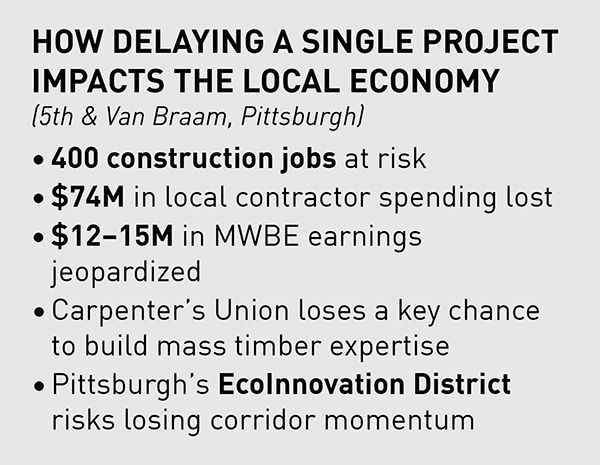 Delays aren’t neutral.
Delays rob cities of desperately needed housing and economic vitality. For example, a new housing development at 5th & Van Braam in Pittsburgh’s Uptown/West Oakland EcoInnovation District (EID) by a Cincinnati-based owner and developer faced delays due to an Inclusionary Zoning ordinance the city briefly considered implementing after the project was already underway. The EID is a high-demand neighborhood that connects Uptown, Downtown, and Oakland and the development’s mass timber design—a highly sustainable building approach—will enhance environmental performance.

When strategy and advocacy are baked into the design process, it can help projects navigate unforeseen delays. Our mixed-use and housing work across multiple markets reveal four strategies that can help cities, community groups, and developers move from gridlock to groundbreaking.
1. Advocacy: Seek out hyper-local knowledge
 Making a building real is about so much more than just design. For our client, 5th & Van Braam is a new type and in a new city for them. Our local expertise has helped them connect with qualified construction partners, the community, and key political leaders. The opportunity to connect with multiple parts of the city helps grow education and advocacy at city hall around the economic impact of the project and the sustainability advantages of its mass timber building approach.
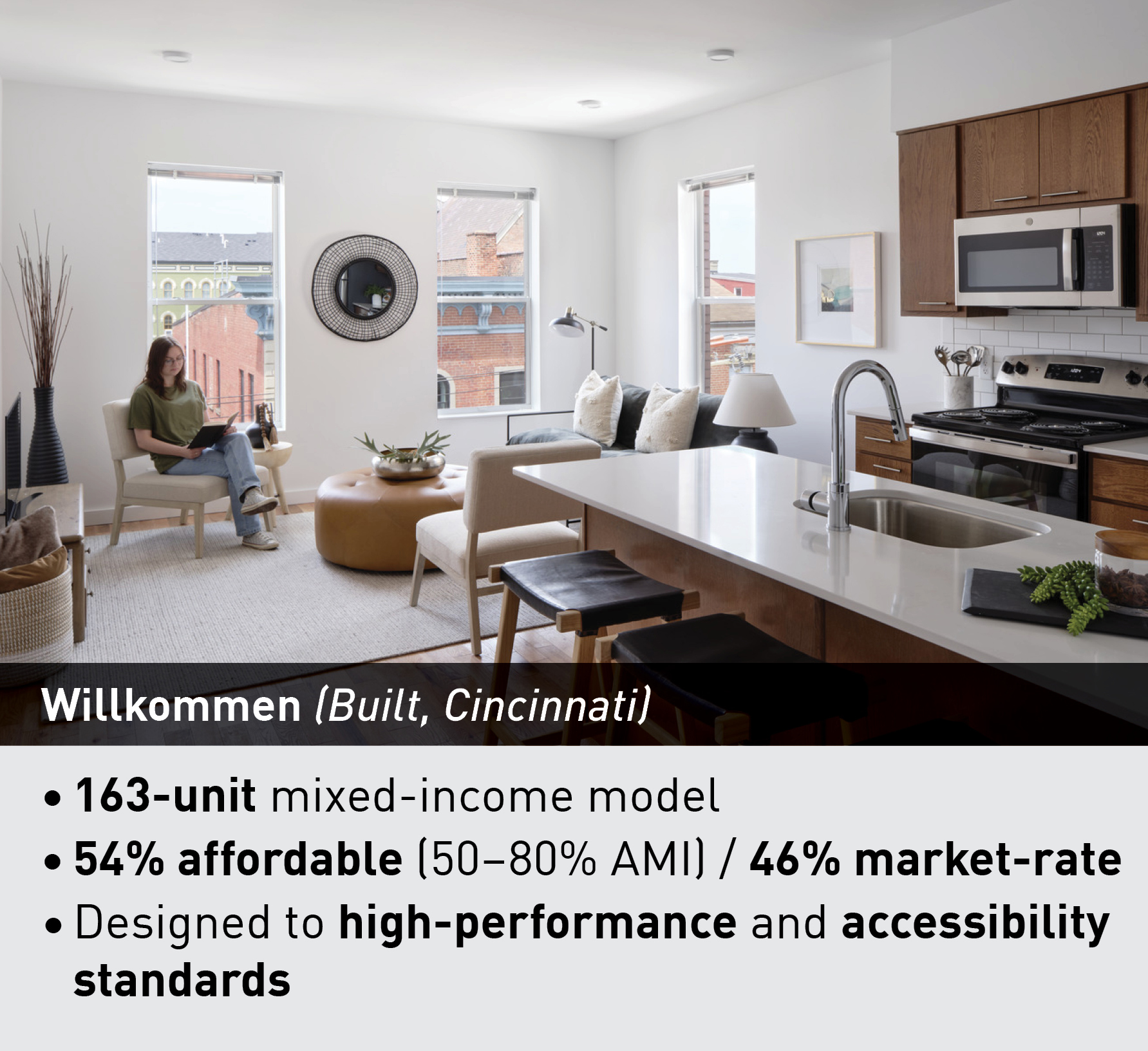
In Cincinnati, Willkommen, a mixed-use development in the city’s Over-the-Rhine neighborhood, GBBN collaborated directly with the city and community members to understand evolving historic guidelines, ensuring new development supports affordability while honoring neighborhood character. Drawing from 13 funding sources—including city support, tax credits, and private investment—the team advanced a financially viable project and worked directly with local contractors and tradespeople to make sure we weren’t sacrificing quality. The affordable units meet high-design expectations and create energy-efficient homes that foster equity and dignity for residents.
2. Advance Local Investment Beyond One Building
As champions for innovative and sustainable construction methods, GBBN helped position Pittsburgh’s first mass timber multifamily project as a catalyst for local workforce development. Recognizing that mass timber is rapidly growing but still unfamiliar to many teams in the region, GBBN brought the Union Carpenter Local 432 into the conversation as soon as Massaro and C.D. Smith were selected as the construction partners for the development at 5th & Van Braam—meeting both state goals of supporting union jobs and the project’s requirement for experienced mass timber builders.
By engaging the union early, GBBN invigorated a dedicated mass timber training program for the local chapter, where there are apprentices constructing model structures, before applying those skills onsite. This proactive collaboration not only strengthened the project team, it opened new pathways for local tradespeople to gain expertise in a construction method that is shaping the future of sustainable housing. This is a win-win for enhancing a skilled local workforce and increasing opportunities for Pennsylvania as an economic competitor with this rising construction type.
3. Communicate with Empathy
 Housing developments don’t exist in isolation, but in context with others in any given neighborhood. But even with clear context, both communities and developers often default to positions shaped by past experiences with unclear or inconsistent processes. Both perspectives add value—communities understand history and needs, and developers understand market realities. Helping communities understand how an individual project will advance broader neighborhood goals can help turn project skeptics into champions. Pittsburgh’s Uptown neighborhood provides a good example. The neighborhood is just a third of a square mile but more than a thousand new housing units are proposed. Those that have broken ground are deeply affordable. However, an emerging balance matters: market-rate housing projects ensure sustainability and balance in the market and create modern, quality housing, which appeals to students and professionals looking for proximity to job centers and campuses. Design-forward, mixed-income developments attract new residents and support the retail and amenity growth that Uptown has lacked.
When neighborhoods already have multiple affordable projects in the pipeline, applying blanket affordability requirements to every market-rate building can jeopardize design quality and financial feasibility, ultimately stalling the mixed-market housing that fuels long-term community stability and economic vitality. Communication around neighborhood context is most successful when it leans into an informing and aligning “here’s how a project supports your vision” approach, versus an approach that disregards or presents as “we know what the neighborhood needs” approach.
4. Lean into Inclusive Revitalization
We believe development is best when it happens with people, not to them. GBBN worked with the Cincinnati Metropolitan Housing Authority to design Logan Commons, a recently completed, newly constructed, LEED Gold affordable senior housing development. This development brings 42 new housing units to the city, all offered at 60% Area Median Income (AMI). Members of the Over-the-Rhine Community Council (OTRCC) hold this project, and its process, up as a good model for how inclusive development can be done. Organized and collaborative, the development team “had it right in getting to us early,” says Mike Bootes, an OTRCC trustee. Leveraging a community as a development partner early can help prevent surprises, and roadblocks, later.
As a design firm, we consider architecture to be beyond buildings themselves.
There is ongoing debate around the best path to affordable housing, but one thing we know for sure: pausing development isn’t neutral. Stalled housing projects at all market levels have direct, economic consequences for cities. Currently in Pittsburgh, over 10 significant residential projects are delayed or unrealized. As reported by the Pittsburgh Business Times, this collectively accounts for over 2,000 apartments in various neighborhoods. When housing projects are left in limbo, local economies lose out in other ways.
Our work sits at the intersection of community, development, and policy, so we advocate, collaborate, and communicate on behalf of our clients and their projects to navigate challenges and position them for success. While we don’t write policy, we work to ensure policymakers, neighborhood residents, and community leaders put housing development into a larger context. This helps grow understanding around how the goals of a neighborhood, a developer and the city overlap.
 Sabreena Woods-Miller is an associate at GBBN and Sabreena leads client development in our Pittsburgh office. She works with GBBN’s market leaders and marketing team to identify and develop relationships with potential clients and community partners who share our value of positively affecting people in communities through our work. A visible advocate of innovative community development approaches throughout Pittsburgh, Sabreena champions collaborative development, informed engagement, productive reuse of vacant properties and develops intentional partnerships to reach creative solutions.