


Insights
5月 19, 2026 _ insights
No One Leaves the House to Wait in Line
Four ways to get the big moves right before the big night
When patrons choose an evening of live music, they are choosing that moment when the house lights go down, when anticipation peaks, and a larger-than-life experience begins. That experience begins well before they see performers take the stage; it begins with choreographing how people arrive, where they queue, what they see first, how they move through the building, and whether the architecture supports the excitement of the night or quietly gets in the way.
Some of the least glamorous elements of concert venue design—where the loading dock goes, restroom locations, how people queue for concessions, the seating strategy—often have the greatest impact on whether the facility operates smoothly.
Here are four tools that we use with venue owners and operators to ensure those big early moves enhance the patron experience:

What do patrons notice as they enter a venue? Where does their attention go when they arrive? What does the building suggest they to do next? Architectural cues shape how people experience space.
 For example: At the Orpheum Theater, a historic presenting venue in Minneapolis, patrons walk by concessions as they enter (pictured on the left). They see a queue growing, and that queue becomes a visible point of congestion. Then, at intermission, patrons remember the line they saw on the way in and avoid it which leads to overcrowding at concession points near the auditorium, while the concession point near the entry is empty. If concession lines are too long, patrons may simply walk away, which means lost revenue for the venue operator.
Where the queue matters most is in the space people occupy while waiting. That is how you identify choke points. You do not want lines backing up into the main hall, but you do want them to remain visible, manageable, and easy to navigate. In a well-designed venue, circulation is not just movement—it is part of the experience.
If guests can see multiple options at once, they will make better decisions faster. If they only see one option, it becomes the default—even if it creates a bottleneck. Understanding the psychology of queuing helps shape placement of physical cues so that patrons can easily understand their options and make their own choice.

Experience is shaped by all five senses. The acoustics, visual hierarchy, textures, and aromas can contribute to how spaces are perceived. Space Syntax Analysis is one tool we use to make those instincts visible, and solvable.
By mapping how people move through a building and how different paths connect, Space Syntax Analysis can reveal where traffic problems exist in a venue and what design interventions might improve them. It allows us to look at a space not just as a set of rooms, but as a system of movement, visibility, and decision-making.
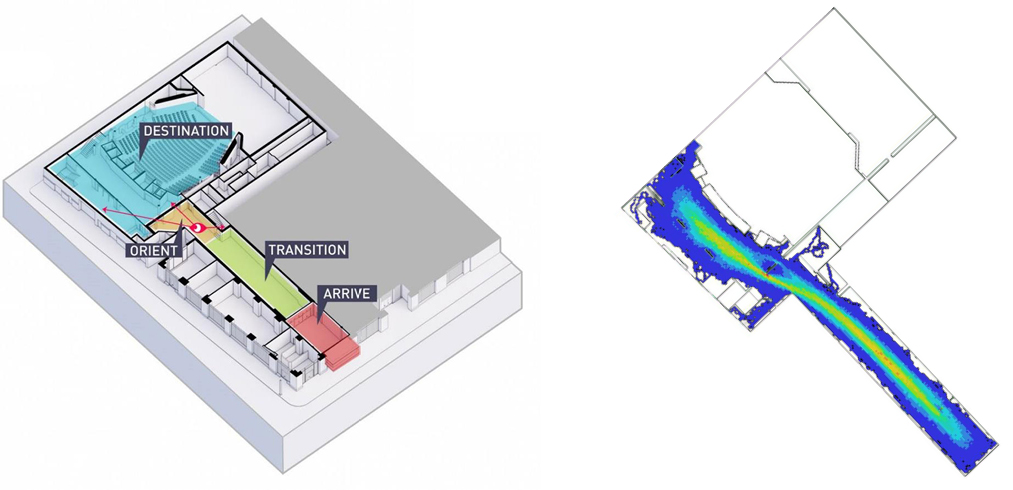
The Byham Theater in Pittsburgh, Pennsylvania, presents a wide range of live music. The diagram (above, left) shows the patron journey from arrival to the auditorium. We used Space Syntax Analysis (above, right) to study how people flow through the building. When patrons enter, how is the building helping or hindering their journey? Where are the pinch points?
As a theater that welcomes many first-time visitors, that first impression matters enormously. The psychology of arriving in a space, orienting oneself, and transitioning to where to go next is critical. A venue should help people understand where they are and where they need to go without requiring them to puzzle it out.
That starts with removing visual barriers and creating clear destinations to completely change how a building feels. In some cases, moving a stair or opening a line of sight can make the difference between a space that feels confusing and one that feels welcoming. The lesson is simple: when people can see where they are going, they feel more comfortable getting there.

Sometimes the best way to understand a venue is to build it twice—once as a physical model and once as a digital one.
Owners and Operators know their buildings well but often regard them only inwardly, not always considering context, or how they interact with their neighbors. During design, we help broaden that view to include the city, the street, and how people will approach the building.
Creating a physical urban model changes the conversation. It gives stakeholders a tangible way to understand how a building fits its site and surroundings, while also surfacing practical issues— including where the loading dock belongs.
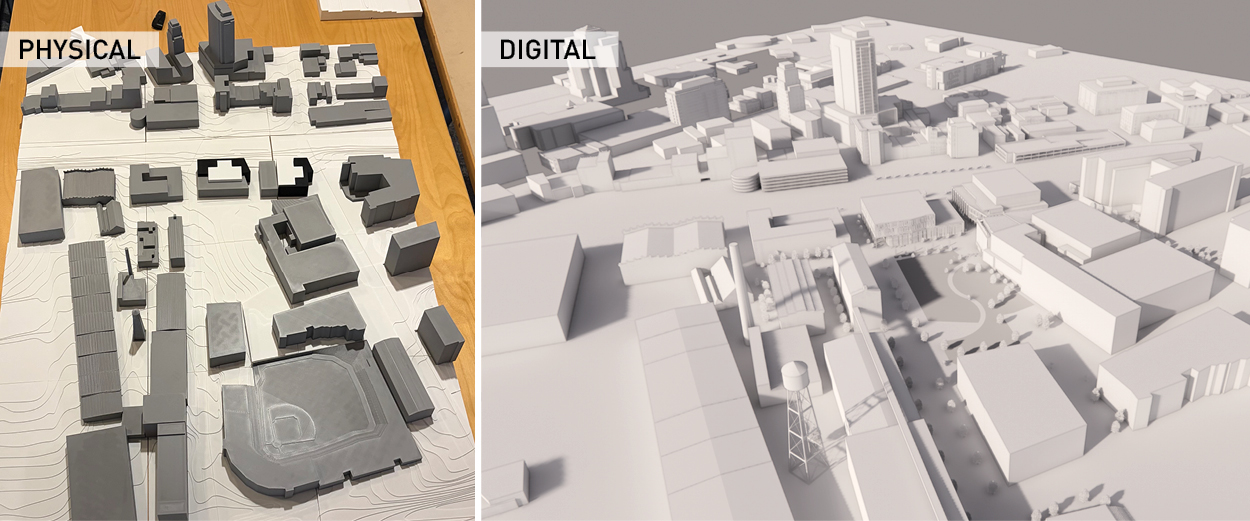
A physical model makes constraints visible and encourages spatial thinking in a way drawings often cannot. Paired with a 3D digital twin, it becomes even more powerful: the model frames the big questions, and the digital version lets us test them in real time. Together, they create a rapid feedback loop that supports earlier, more practical operational decisions.
Most of the patrons who will come to D2 Live, a new indoor live/amplified music venue in Durham, North Carolina, will be coming from outside the city. During concept design, the models we created helped stakeholders understand wayfinding and how the front door might appear to first-time visitors. They also illustrated how the venue will fit within a three-building complex and the surrounding civic space. The models enabled a robust dialogue resulting in a broader appreciation for the potential street-level activities such as community-based festivals.

In venue design, seating is about more than seats.
That understanding led us to developing a proprietary tool that allows design teams and clients to quickly test seating configurations to better understand earning potential—as well as the building costs and patron experience impacts—of different rakes (the overall slope of the floor), the rise (the vertical distance between rows), seat counts, and layouts.
For example, even a seemingly small change to a design—such as moving the first row closer to the stage—can ripple through the entire seating bowl, a venue’s largest element. Small changes like this can impact a building’s overall size and operational economics. We are able to test sightlines, evaluate economic implications, and quickly iterate through dozens of options and scenarios to find the version that best supports the project’s goals.
This has been true for three of our recent music venues: The Farmer Music Center (currently under construction), The Heights 2.0 (in design), and D2 Live (concept design completed). If a project needs to reduce square footage without compromising patron experience, seating is often where the biggest decisions must be made. At The Farmer Music Center, the tool helped stakeholders understand in the first phase of design that they could reduce the overall size of the building without losing seating capacity. That clarity made the conversation more productive and gave the client more confidence about delivering on their business objectives.
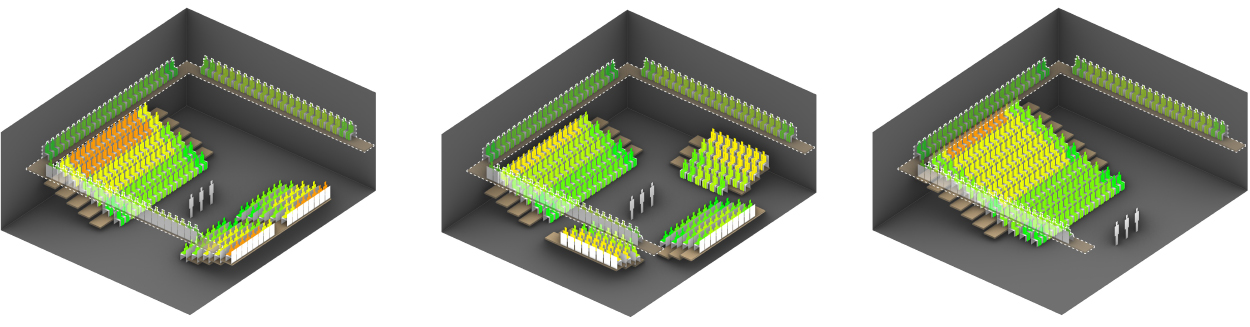
The proprietary seating tool we developed in house allows quick iterations of different seating configurations, letting clients understand impacts to patron flow, egress, and traffic to concessions. At the Byham Theater, more popular wider seats could be accommodated while proving they didn’t have to lose as many seats as they initially thought.
Musical acts selecting venues to round out their tour rosters command a significant share of the ticket take, while the venue operator retains food, beverage, and amenity revenue. In many cases, the artist take is based on the number of seats, which means seating decisions have immediate financial consequences. So, the ripple effect is real and it starts long before the first ticket is sold.

Taking time to work through early decisions helps ensure the venue supports the experience you want to create. When people choose to go out instead of staying in, they arrive at performance venues with big expectations of an experience they can’t get at home. Making their big night out a success is shaped by a series of strategic early decisions: how people arrive, what they see, how they move, how many seats are possible, where the queues form, and how the building fits into the city around it.

If you’re starting to think about improvements to your performance venue or just want to dream about the possibilities, we’d welcome the chance to talk about the decisions that could unlock future success for you.
 Daniel Luegering is an associate principal at GBBN. He uses rapid iteration and discussion to help arts clients envision their future and how design can get them there. His process enables design teams to dig beneath the surface, unearth hidden obstacles, and transform them into opportunities that help arts organizations, from community theaters and black box performance spaces to live performance venues and dance centers, achieve their goals, excite patrons, and enrich their communities. His work includes The Farmer Music Center and The Cincinnati Shakespeare Company theater expansion in Cincinnati, Ohio; The Heights 2.0 in Dayton, Ohio; D2 Live in Durham, North Carolina; the Byham Theater in Pittsburgh, Pennsylvania; and the Orpheum Theater in Minneapolis, Minnesota.

 Scott Kyle is an architect and associate principal at GBBN. He has a passion for live music which he has woven into his project leadership, enabling client relationships built on trust and the deep understanding of business and facility operations. With over 30 years of experience designing and managing arts and mixed-use real estate development projects, he has made versatility his specialty. He helps foster sustainability expertise throughout the firm while also providing technical and design expertise on multiple project types. His recent live music venue work includes The Andrew J Brady Music Center and The Farmer Music Center in Cincinnati, Ohio; The Heights 2.0 in Dayton, Ohio; and D2 Live in Durham, North Carolina.