

Insights
Jan 8, 2026 _ insights
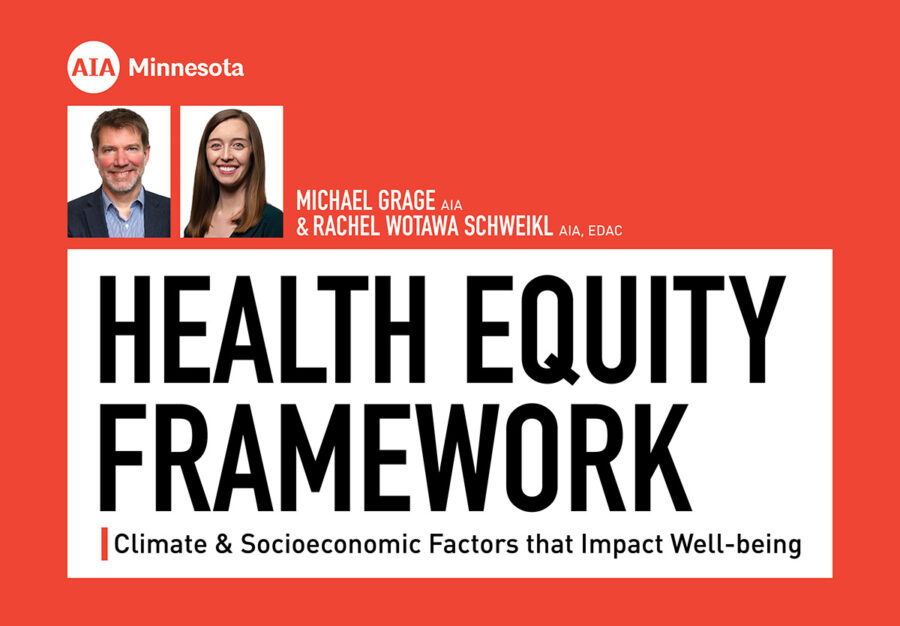
Health Equity Framework: Climate & Socioeconomic Factors that Impact Well-being
Intermediate Health equity is established when everyone has a fair opportunity to achieve optimal health. This requires removing obstacles to good health such as poverty, discrimination, powerlessness, and lack of access to good jobs with fair pay, high-quality education and housing, safe environments, and health care. With the Centers for Medicare and Medicaid Services’ 2025 focus on prevention, wellness, and chronic disease management, health equity becomes important because of its effect on people’s overall sense of wellness. By considering concepts such as salutogenesis (a focus on the origins of health and well-being rather than the origins of disease) and a building’s capacity for enhancing its occupants’ resilience, a set of factors emerge that can be arranged into a toolkit.
We recently introduced a framework for health equity and a toolkit as part of a panel at the American Institute of Architects Minnesota Conference on Architecture. The framework and toolkit can be used to gauge a building’s impact on its community. The panel included a case study that evaluated a recently completed cancer center in regard to how it reacts to the proposed framework.
See the presentation here.
Learn more about health equity here.
Read more about the health equity framework here and here.
See more of our healthcare work here.
 Michael Grage, AIA is a principal at GBBN. For Michael, healthcare architecture is a collaborative process of conversation and discovery that surfaces the right solutions to his clients’ biggest challenges. Working with nursing staff, doctors, and caregivers, Michael uses his 20 years of experience in design and project management to ensure that every voice is heard. By deploying the right technologies and tools, Michael helps teams streamline the design process while helping project stakeholders better understand their physical space and how different design options will impact its function and feel. Michael’s recent projects include Mercy Health’s Kings Mills Hospital, and a new cancer care facility for CHRISTUS St. Vincent Hospital.
 Rachel Wotawa Schweikl is an associate at GBBN. Drawn to the complexity and impact of healthcare architecture, Rachel is a medical planner who brings designers and end users together to solve our clients’ trickiest puzzles. Balancing form and function, she helps discover operational efficiencies while creating uplifting spaces for patients, their families, and medical providers. Rachel understands that at its core, architecture is about people. That’s why she prioritizes listening and collaborating on design problems.