News
Jul 22, 2026 _ news
The Citizen Science Lab Cuts Ribbon on MLK Center of Scientific Excellence
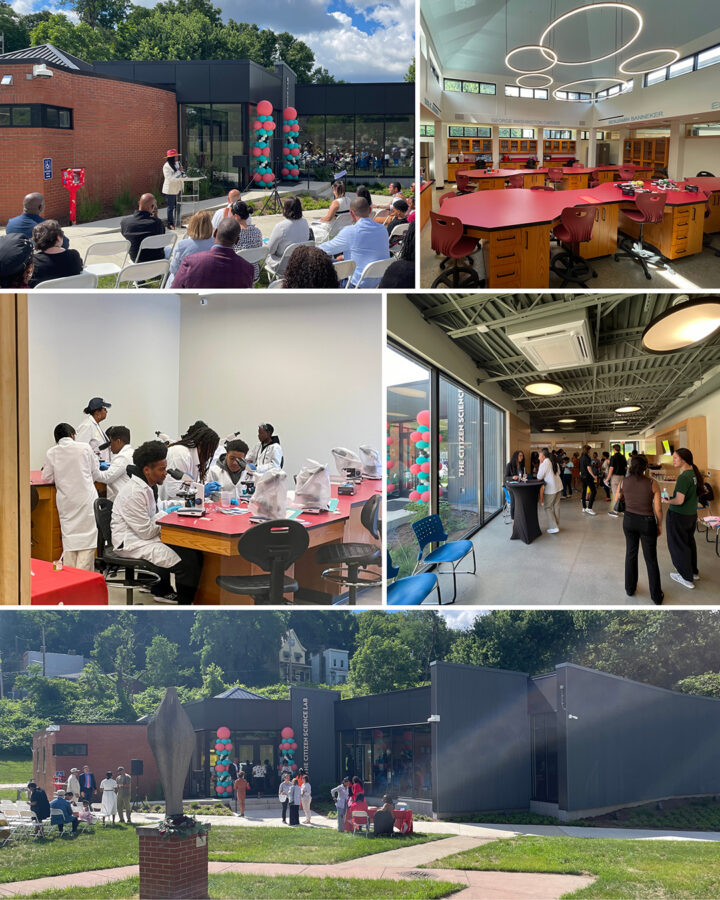
The Citizen Science Lab (TCSL) grows young scientists of color in the Greater Pittsburgh area through hands-on, life-changing experiments. Since its founding in 2015, TCSL has impacted over 4,000 school children through summer camps and after school programming. The organization recently cut the ribbon on its new home in Pittsburgh’s Hill District neighborhood, allowing TCSL to expand its operations.
In his remarks at the Juneteenth ribbon cutting ceremony, TCSL’s Founder, President, and CEO Dr. Andre Samuel said, “The Hill District deserves access to world-class experiences right here in our own neighborhood. This building once again becomes a place where knowledge, imagination, and opportunity will flourish.”
We helped TCSL realize its dream to return to its roots in the Hill District by transforming the former Martin Luther King Jr. Reading and Cultural Center into a vibrant, visible, and state-of-the-art STEM laboratory in the community. The new center allows TCSL to expand concurrent programs and provides enhanced food science components including a dedicated area for a future greenhouse and chicken coop. It also supports outdoor drone instruction and offers welcoming spaces for students to study, complete homework, collaborate, and socialize.
Being sustainable was also key design goal All-electric systems and insulation that is 25-30% better than code mean the building will be efficient to operate and comfortable throughout the year. In the parking area, permeable pavers with a large detention system below ground capture water, allowing it to slowly seep out and avoid flooding during storms. Clerestory windows in the main lab create a light, bright space that supports excitement and curiosity. Carpet patterns in the offices are based on biophilic mycelium structures, and the building is imbued with color to match the energy and enthusiasm of the scientific experiments happening within.
“Dr. Samuel and The Citizen Science Lab’s love of science fueled the design team to look for opportunities to use the building itself as an educational tool,” says Chris Guignon, part of GBBN’s project team. “Exposing structural and mechanical systems became intentional moves to allow young scientists to see the inner workings of the building, which also celebrates natural grains and aggregates of wood, concrete, and brick materials.”
See more of our adaptive reuse work here.